Google
  Web shaunsre.blogspot.com   

Friday, January 18, 2013

How To Read A Property's Financial Statement - Expenses Section

Last week, I looked at the Income section of a multi-unit property's financial statement. This week, I'll look at the Expenses section. This part of the statement is actually the most straightforward - it details all the things that management had to spend money on. Again, these are actual values from the Houston apartment complex, this time or February 2012. Here's the summary:


The first column of figures is for the month of February and the second column is the year to date amount (January and February 2012, in this case).


Later in the report, you'll see each section broken down further:


As you can see, the breakdown gives us more detail into how exactly the money in each category is being spent. For example, the Apartment Turnover figure is broken down into costs for general cleaning, re-painting, and carpet cleaning.

This is all fairly straightforward stuff but I enjoy reading it to get a better sense of where money is being spent.

Friday, January 11, 2013

How To Read A Property's Financial Statement - Income Section

As I was looking over last month's apartment numbers, I realized there was a term on the financial statement that I never really paid much attention to and that some people might not have a good idea of the meaning of. I thought it might be worth explaining how the income portion of a financial statement is filled out and what each term means.

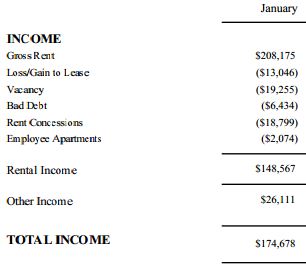
Below is the actual Income portion of the financial statement for the Houston apartment complex for January 2012.


Negative numbers are shown in parenthesis. Let's go over each term.

Gross Rent -  This is the amount of rent that would be collected if every unit in the apartment was rented at market rates.

Loss/Gain to Lease - This is the term I figured some people might not know about. Apartments are typically rented out on a 1 year lease. Sometimes longer, sometimes shorter, but typically the tenant signs a contract to pay a certain amount of rent each month for a set number of months. Suppose a tenant signed a lease to pay rent of $500 per month for 1 year and that this is the typical rent for the area at the time of lease signing. Now suppose that after 6 months, due to improvements in the property, a stronger housing market in general, or other factors, the typical rent for a similar apartment in the area rises to $600. At that point, if a new tenant were to rent this apartment, management could charge $600, but since the existing tenant has a contract to pay only $500, the property is losing out on on $100 per month. This is known as "loss to lease" - We've lost $100 in income because the tenant has a 1 year lease preventing us from raising rents. The opposite also applies - if typical rents drop to $400, then we have a "gain to lease" of $100 per month because the tenant is paying $100 more than we could charge a new tenant.

Vacancy - This is pretty obvious. If an apartment is not rented, this is the amount of rent we are losing.

Bad Debt - Income we are owed, but have not been able to collect. For example, if a tenant bounces a check, that rent amount is bad debt (at least until it has been collected).

Rent Concessions - How much we give away in order to get tenants to sign leases. When you see advertisements for apartments that say "First month's rent free!", that is a rent concession and the amount of one month's rent would show up in this category.

Employee Apartments - Managers and / or other building employees sometimes live on site and, in exchange for their services, get either free or discounted rent. This line tracks this amount.

Notice that these amounts, even though they are negative, show up in the Income portion of the financial statement, not the Expenses section. This is because they are not actual amounts we have paid out. They represent reductions in the maximum possible income the property can achieve (as given in the first item, Gross Rents). The Expense portion of the financial statement only contains amount we have actually paid out.

So, as an investor, what you want to see when looking at a property's financial statement is the Gross Rent figure rising and the other figures decreasing (or getting closer to zero). In most cases, the monthly Gross Rent is typically assumed to be static for an entire year, even though market rents may vary month to month. This is just to make budgeting, reporting, and forecasting easier. However, if you are able to look at the financial statements of a property for multiple years, look for this number to be rising each year.

Loss / Gain to Lease is something you want to see approaching zero. A positive number ("gain to lease") is nice in the short term, but that would mean most of your leases are at above-market prices. In turn, that means tenants will probably be moving to a cheaper property when their leases are up and it may be hard to attract new tenants. Here is a chart of the monthly loss to lease numbers for my apartment for this year (through November):


Not too bad. Pretty big losses, but at least it's trending in the right direction.

I hope that gives you some insight into how to read the income portion of a financial statement for a rental property.

Tuesday, January 08, 2013

November Apartment Report

Last month, the apartment complex hit a bit of a rough patch. We saw declining occupancy and increased vandalism. I'm pleased to report that things have improved during November. Occupancy increased and rent concessions decreased, so it appears the new property manager is doing well. We hit our highest monthly total revenue number since June and the third highest for the entire year. This was also an $8,000 improvement over October's figure. Our net income figure also rose to $5,700, which is $1,500 higher than last month and the highest figure of the year.

Expenses continue to be stable and we are almost $4,000 over our monthly budgeted net income figure. Unfortunately, our net income for the year overall is still $45,000 under budget, due to the poor performance during the first half of the year. Next month, our $8,000 reduction in our mortgage payment kicks in, so we should see some really good numbers for December.

Thursday, December 27, 2012

2012 Year In Review

As 2012 comes to an end, it's time to look back over what I accomplished in the year with regards to my real estate investments.

I made a total of 5 hard money loans over the course of the year. Four of those are still active. None were delinquent and none defaulted. The investment in the apartment complex gave me a bit of worry for a couple months, but in the end, it appears to have regained its footing. I did not invest any more money when management made the cash call in February. On the other hand, the property has not been generating any income for me either. Things appear to be heading in the right direction now, after hitting a bottom around mid-year. Right now, I'm getting close to $1,000 a month in passive income. This is purely from my hard money loans. If the apartment complex was paying interest as planned, I'd be well over that figure. When I started this blog seven and a half years ago, getting $1,000 a month in passive income was a goal. I didn't get there as soon or in the way I thought I would. It took longer and I ended up going into hard money investing rather than buying and renting properties, but the end result is the same.

Next year, I plan to continue with the hard money lending. I'll probably increase the funds I am using for that slightly, although I have several personal plans that might eat up my funds instead. The plan for the apartment is to continue to let it run and start looking at selling it towards the end of 2013, so any sale probably won't happen until 2014.

Monday, December 03, 2012

November Update

I've got two updates today. First, the sale of HML #22 has fallen through. Our borrower is looking for a new buyer. I don't have any info as to why the deal didn't happen.

I also received the October update for the Houston apartment complex. Things have gone wee bit south since the last yearly conference call several weeks ago, although some offsetting factors have prevented that from being reflected in the bottom line. Occupancy decreased to 89%. Management says this is due to a combination of factors, including some crime issues that have affected not just our property, but other apartment complexes in the area as well. In addition, we have seen some increased competition from nearby properties in the form of increased rent concessions. There was also some management turnover in the front office and the interim property manager was not up to the task of running the property. Management has addressed these issues by bringing in a more experienced manager from another property to run ours. Perhaps a more seasoned manager would not have allowed the competitor's rent concessions to have had such an impact on our occupancy.

Management says they have also worked with the Houston police department to increase patrols at our property. I'm not sure how effective this will be. If crime is an issue at other properties as well, I imagine the police may be stretched a bit thin trying to increase patrols at all properties. We may end up seeing a return to the use of a private security company for patrols.

Expenses declined due to seasonal decreases in utility usage, as well as the previously mentioned staffing decreases. Overall, we saw a reduction of $10,000 in expenses for October, bring our net operating income to a positive $4,200, the second highest monthly total of the year. Given that this increase is based mostly on one-time events, I would not expect this type of performance to continue.

Or should I? We also received the 2012 real estate tax bill, which features the new property assessment value. As a result of the lower assessment, the amount our lender is collecting for the property tax escrow account is decreasing by about $8,300 per month, beginning in December. That is a huge savings that will go straight to the bottom line.


© 2006 Shaun | Site Feed | Back to top